







Quick Answer
Solo travel for women over 50 changes your pace and planning. It doesn’t change your judgment, your curiosity or your right to go.
What changes falls into three areas: how much energy you plan per day, how you separate real risk from assumptions about age, and how you handle people who ask whether this is a good idea. This guide uses the PACE Recalibration, four checks that sort real adjustments from borrowed worries.
You’ve traveled before, or you’ve wanted to, and now a milestone birthday, an empty house or a change in circumstances has put solo travel back on the table. The hesitation isn’t really about whether you can do it. It’s the quiet worry that starting again at this age looks foolish, or that your body or your judgment has changed without asking you. That worry deserves a straight answer, not a pep talk.
I’ve traveled solo since 2001 and consulted 200+ nervous first-time travelers. The PACE Recalibration comes from patterns in those consultations. It is a planning framework, not testimony from women over 50, so check each step against your own health and history.
Nobody Warns You What Actually Changes
The common assumption goes like this: solo travel is a young person’s activity, so a woman doing it later must be either fearless or in denial about the risks. That assumption causes real problems. It pushes women to over-prepare for a trip that doesn’t need it, to join a group tour by default instead of by choice, or to shelve the plan because defending it to skeptical family feels like more work than the trip.
Most advice doesn’t help, because it was written for first-timers in their twenties or for retirees on structured tours. Neither answers what is different about a solo trip past 50, and what isn’t.
Readiness here isn’t about proving your body or your nerve match what they were decades ago. It’s about knowing which parts of your old approach still work and which worries are borrowed from other people’s assumptions. If you’re still weighing whether solo travel is worth it in the first place, that question comes first.
PACE is built for the reader who has already decided she wants to go and needs to know what to adjust.
The PACE Recalibration
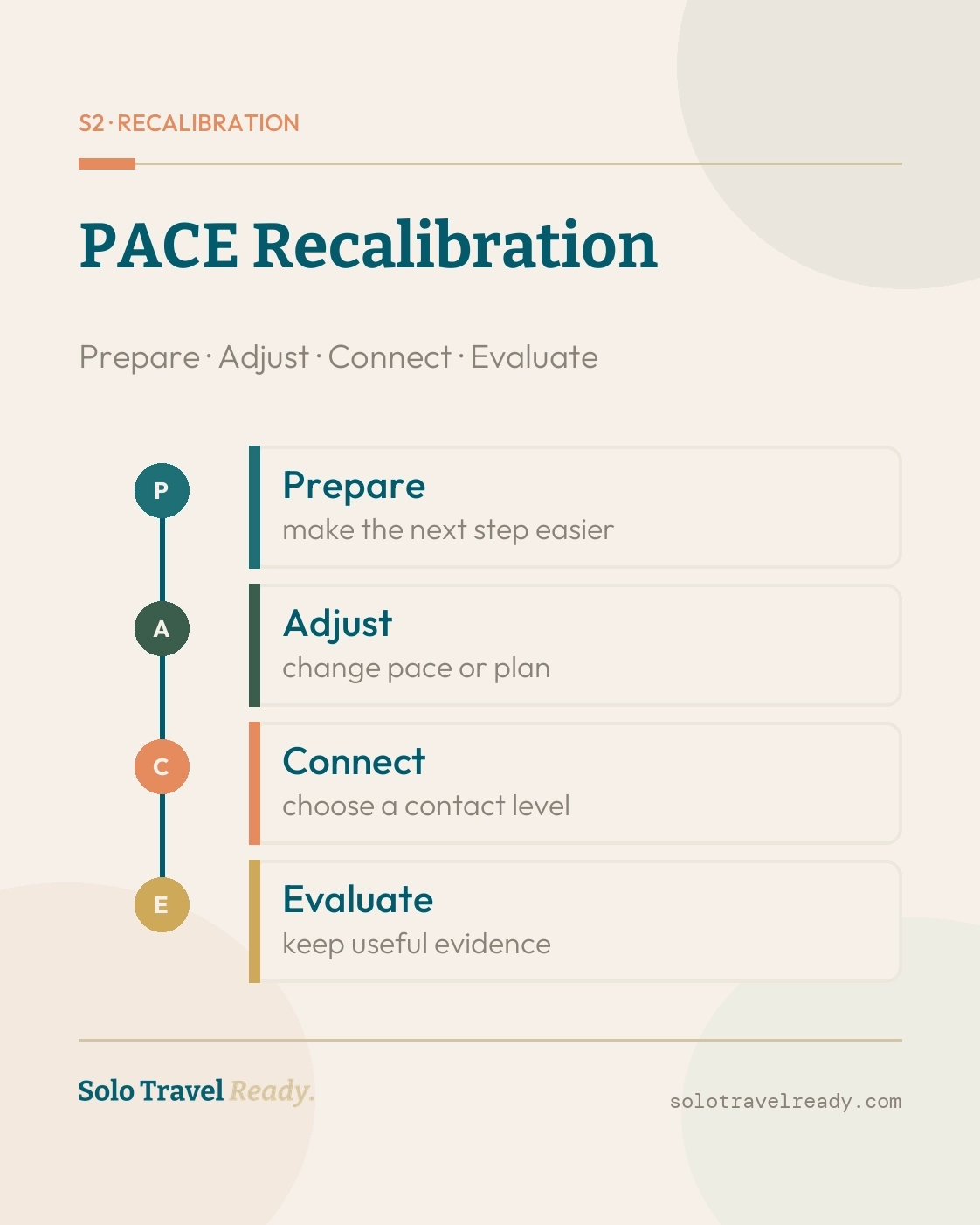
The PACE Recalibration is a four-part check: Pace, Assess, Communicate, Equip. It sorts real adjustments from borrowed fears and gives each one a specific action instead of vague reassurance.
Run it while you plan, when a relative questions the decision, when you compare a solo itinerary with a group tour, and again once you’re on the ground and your real energy shows itself. It keeps the doubts that need planning separate from the ones that only need an answer.
P: Pace
Plan your daily rhythm around your current energy and recovery, not the pace you kept at 25 or 35. Build in one rest day for every four to five active days, and choose lodging within easy reach of food and transport instead of chasing the lowest price. That takes about ten minutes while you plan.
The ratio is a rule of thumb, not medical advice, so adjust it with your doctor if a health condition affects your stamina. Slower isn’t a compromise. You see fewer places and know them better.
A: Assess
Separate the safety facts about your actual trip from general assumptions about age. Check three things: your destination’s current government advisory level, your accommodation’s location and recent reviews, and how easily you could reach help from where you’ll sleep. That takes about fifteen minutes. A relative’s discomfort is not evidence that the trip is unsafe.
C: Communicate
Decide before you leave what you will and won’t discuss with people who question the plan. Write one sentence that states the decision without inviting a debate, and one limit on what you won’t keep re-explaining. That takes about five minutes and saves far more later.
E: Equip

Build the few systems this life stage leans on: a written list of your medications and doses, a copy of the prescriptions, insurance that matches your real health situation, and a check-in routine with one trusted contact.
Confirm that your medicines are allowed at your destination before you fly, because some countries restrict certain prescription drugs. If you’re comparing policies, what solo travel insurance should cover lays out the questions to ask. Set it up once and reuse it: the first time takes about twenty minutes, and later trips take almost none.
Is It Safe for a Woman Over 50 to Travel Alone?
Yes. Age alone doesn’t decide safety. Your destination, your lodging and your check-in plan matter far more than your birth year.
The factors that shape safety are the same ones as always, checked with a little more care. Is the accommodation central, with recent reviews? Is transport reliable after dark? Do you have a plan if a health problem starts far from home?
None of that is unique to being over 50. What shifts is the weight of Equip: insurance, medication logistics and a clear check-in routine matter more than they did on a first trip in your twenties.
Apply Assess to your specific route and lodging before you book, not to “solo travel over 50” as a category. For the wider method behind that check, how to judge risk for any solo trip walks through it step by step. The category isn’t the risk. The trip is.
What Actually Changes After 50
Energy and Pace Become Planning Inputs, Not Afterthoughts
A younger traveler can improvise a packed day and recover overnight. After 50, plan recovery into the itinerary from the start.

That’s the whole adjustment, and it costs you nothing but a slower day. Use Pace to place rest before you feel you need it, so a quiet afternoon never reads as failing to keep up. If your energy varies with a health condition, plan two or three low-effort days in the same week instead of one.
Safety Perception Shifts, Even When the Risk Doesn’t
People around you, and sometimes you, may treat the same trip as riskier because you’re older, even when nothing about the actual risk has moved. Use Assess to check what really differs for you (health logistics and insurance, mostly) and what is perception catching up with an outdated idea of age and vulnerability.
Your Social Circle Looks Different, Not Smaller
An empty house, a change in relationship status or friends who’ve stopped traveling can make solo travel feel like it’s filling a gap instead of being a choice. If loneliness is the loudest part of the worry, whether solo travel actually feels lonely answers it head on. A trip can fill a gap and still be your own choice, and the gap doesn’t make the choice less valid.
What Doesn’t Change
Your Judgment Isn’t Reset by a Birthday
The decision-making that carried you through decades of work, relationships and emergencies doesn’t vanish because you’re planning a trip alone. Use the same judgment here that you’ve trusted elsewhere.
Curiosity Doesn’t Expire
Wanting to see a place, try something new or have an experience that belongs to you is not a young person’s impulse that you’re supposed to have outgrown. It’s a reason on its own and needs no second justification.
The Skills You Already Built Still Count
Budgeting a trip, reading a map, negotiating a booking and handling a delay are skills you’ve likely used for years. How small independent decisions build self-trust at any age explains why those skills carry over. They are evidence you’re already equipped, not proof you need to start from zero.
Handling Family and Friends Who Question the Decision
Where the Pushback Actually Comes From
Most objections aren’t about your capability. They come from someone else’s worry, an outdated idea about age or discomfort with a choice they wouldn’t make. Naming the source doesn’t end the concern, but it shows the objection is about their comfort, not your risk. If gender adds another layer to that pushback, what changes when a woman travels alone at any age covers the parts that are about being a woman, separate from age.
A Script for the “Is That Safe at Your Age” Conversation
Prepare one calm, factual sentence in advance, such as, “I’ve done the research and I have a check-in plan. I’m going.” You don’t owe a longer defense. Repeating the same short answer works better than building a new argument every time.
When to Listen and When to Move Forward Anyway
A specific advisory or a documented health concern is worth weighing seriously. General discomfort with the idea of you traveling alone at your age is a different category, and it doesn’t require a change of plan.
Solo Trip or Small Group Tour: How to Decide
Choose independent travel for full control of your pace. Choose a small group built for solo travelers for company without a travel partner.
Neither option is the safer or more serious choice, whatever the marketing implies. The decision depends on what you want most from this particular trip. Full control of your schedule and budget points to independent travel. Company for meals and activities, without needing a travel partner, points to a small group, though how to plan connection on a solo trip without a group shows you can build company into an independent trip too.
You can also mix them: travel independently for most of the trip and join a group for the stretch where local knowledge matters most. Check a group operator’s cancellation terms and its solo-traveler pricing before you book, since single supplements vary a lot. Either format works with the same PACE checks.
Three PACE Recalibration Scenarios
These scenarios are hypothetical illustrations, not a specific traveler’s case. Each shows PACE applied to an ordinary decision.
The Skeptical Sibling (hypothetical). A sibling calls the week before you leave and asks whether traveling alone “at your age” is wise. Communicate: give the sentence you prepared and don’t reopen the decision. Assess: if the sibling raises a specific, checkable concern, verify it and adjust if it holds up. Otherwise the plan stands.
The Day That Runs Long (hypothetical). A full day of sightseeing leaves you more tired than planned, and tomorrow is packed. Pace: swap tomorrow for a slower day and adjust on the ground instead of pushing through. Equip: check that your accommodation and medication schedule still match the new timing.
The Insurance Question (hypothetical). A minor health problem appears mid-trip. Because your insurance details and medication list are already in one place, the decision is about the problem, not about finding paperwork under pressure. Assess whether it needs local care or can be watched, and tell your check-in contact either way.
Your Low-Stakes Restart Weekend

A short, reversible trip tests the plan before you commit to a bigger one.
- ☐ Book one or two nights somewhere within a few hours of home
- ☐ Choose centrally located accommodation with recent reviews
- ☐ Pack your medication list and insurance details, even for a short trip
- ☐ Set one check-in time with a trusted contact
- ☐ Build in one deliberate rest block, even on a two-day trip
- ☐ Complete one meal or activity entirely on your own terms
- ☐ Note afterward: what pace worked, what you’d adjust, what wasn’t actually a problem
Mistakes That Undermine a Later-Life Restart
Planning the Trip You Took at 30
Reusing an old itinerary style, with packed days and little recovery, sets up frustration that looks like incapability when it’s really a pacing mismatch. The PACE fix: apply Pace while you plan, not after the trip has worn you down.
Treating Every Relative’s Worry as Data
Absorbing every piece of unsolicited concern as real risk leads you to prepare for threats that don’t match your trip. The PACE fix: run Assess on the specific concern before you decide it deserves a change of plan.
Skipping the Paperwork Because “It’s Just a Short Trip”
Medication lists, insurance details and emergency contacts feel unnecessary for a quick getaway, then turn out hard to produce when something goes wrong. The PACE fix: do Equip once and reuse it whatever the trip length.
Measuring the Trip Against Who You Used to Be
Comparing this trip with how you traveled decades ago, and treating every difference as decline, undercuts confidence that has nothing wrong with it. The PACE fix: use the three-line evidence note from the psychology guide to write down what actually happened on this trip, then judge it on that record.
The PACE Recalibration at a Glance
- Age changes your pace and planning inputs. It doesn’t change your judgment or your right to go.
- Pace the itinerary to your current energy, not a past one.
- Assess the specific trip, not the category of “solo travel over 50.”
- Communicate a short, calm answer to pushback and don’t over-explain.
- Equip once with a medication list, insurance and a check-in routine, then reuse it.
- Next action: schedule the restart weekend above.
Frequently Asked Questions
What Is the Best Way for an Older Woman to Travel Alone?
Book central lodging with recent reviews, add one rest day for every four to five active days, and set a check-in routine before you leave.
Do I Need Different Travel Insurance at This Age?
Your needs depend on your health history and medications more than on your age. Check that the policy covers pre-existing conditions, the medicines you carry and medical care abroad. Some policies set age limits or extra charges, so read the age terms before you pay, and ask the insurer in writing if anything is unclear.
What If a Health Issue Comes Up Mid-Trip?
Keep a written medication list and your insurance details where you can reach them, and decide in advance who you’ll contact first. Decide whether the problem needs local care or can be monitored, and update your check-in contact either way, even if it turns out to be minor.
Choose Your Next Step This Week
You came in wondering whether age had made solo travel something you now have to justify. The PACE Recalibration replaces that question with four checks: Pace, Assess, Communicate and Equip. What’s left is a trip and a short list of adjustments, not a verdict on whether you’re still capable.
This week, do one of two things. Book the low-stakes restart weekend above, or, if you already have a destination, spend fifteen minutes running Assess on it: the current advisory, your lodging’s location and reviews, and the route to help.
Tools and Resources
Tools used
- A written medication and insurance summary, kept in one place, for the Equip step.
- A calendar reminder for check-ins, for the Communicate and Assess routine.
- Recent-review filtering on your booking platform, for choosing lodging.
- A one-sentence answer, written in advance, for the family pushback conversation.
Official resources
This is a universal guide, not a destination guide, so it carries no fixed advisory list. Assess is the step that covers that: check your destination’s current official government travel advisory before you book, and confirm your insurance covers your health situation.
Start Building Travel Readiness
Your Free Prep System.
Not tips, not wanderlust, not “just go for it” advice.
Real systems. Honest experience. One focused email a month. Get 3 Free Tools the moment you join:
1. 60-Day Solo Travel Ready Checklist
Your complete prep timeline from decision to departure
2. First 48 Hours Arrival Survival Card
The exact protocol for landing confident, not lost
3. Booking Confidence Checklist
The tool for the moment the booking button feels impossible to press
No schedule pressure. Unsubscribe any time.
About the Author
Zisco Nueda is a solo travel educator and preparation-systems designer who has traveled solo since 2001, starting with Thailand, Malaysia and Singapore, and has since visited 35+ countries, with the deepest experience in Southeast Asia. Zisco created the Confidence Bridge framework this article belongs to, and built the PACE Recalibration from patterns in consultations with 200+ nervous first-time travelers. It is a planning framework, not medical advice or testimony from women over 50, so talk to your doctor about health decisions. Advisories, insurance terms and entry rules change, so verify them independently before you travel.
Last updated: September 2026.