







The short answer
There’s no single best travel eSIM. Pick by route and data need: a regional plan for multi-country trips, one for a single country, 1 to 3 GB a week.
A few providers show up near the top of almost every honest list: Airalo for the widest coverage, Saily for built-in security, Holafly for unlimited data, and a budget provider for short light trips. But those are fits, not winners. Which one is right depends on your trip, and this guide gives you the four questions that decide it.
If the technology itself is still unclear, what an eSIM is gives you the plain definition before you compare providers.
What decides the pick is four things: your route, your real data need, your must-haves, and the strength of the local network where you’re going. Get those straight and the shortlist takes under a minute, and the downside of a wrong pick is a few dollars, not a ruined trip. Once you’ve made the choice, how to set up a travel eSIM shows the next steps.
The Fit-First Pick
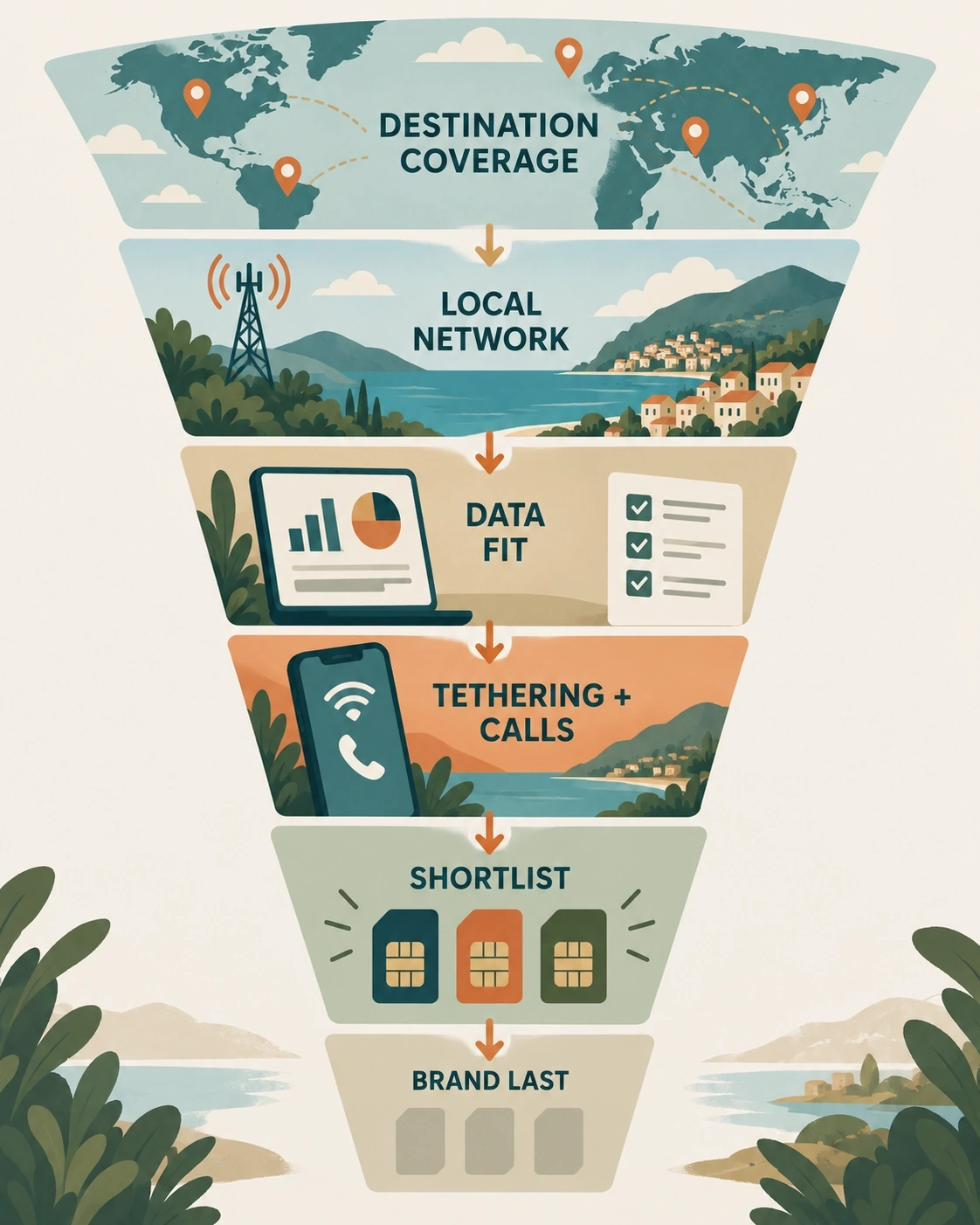
Brand is the last thing to decide, not the first. Answer these four questions before you buy.
Criterion 1: Your route
One country means a single-country plan, which is almost always the cheapest per gigabyte. A region, such as several countries in Europe or Southeast Asia, means a regional plan. Many regions, or a route that does not fit one region, means a global plan or one that covers your whole itinerary. If you are deciding whether an eSIM suits the trip at all, the eSIM-versus-physical-SIM comparison weighs the fallback options by route.
Criterion 2: Your data need
Maps, messaging, and light browsing come to roughly 1 to 2 gigabytes a week. Add regular social media and photo uploads and you are around 3 gigabytes. Tethering a laptop for work or streaming video daily pushes you to 10 gigabytes or more, or an unlimited plan. The data section below has the per-activity figures.
Criterion 3: Your must-haves
Do you need a local phone number? Few travel eSIM plans include one, so if you do, that narrows the list fast. Do you want a built-in VPN or security layer? Saily bundles one. Do you hate tracking gigabytes and would rather pay for unlimited? Holafly specialises in that.
Criterion 4: Network quality where you’re going

The eSIM is only as good as its local partner network. Where a provider lists the network it uses for your destination, check it. In a country with one clearly dominant carrier, you want the eSIM that partners with that carrier, whatever the brand on the app.
Quick picks by traveller type

The right pick depends on what kind of trip you are taking, not on a single crowned winner. If you’re still weighing whether an eSIM is even the right category, start with the physical-SIM alternative before you shortlist a provider.
Which eSIM is best for a first solo trip?
For a first solo trip, a regional plan from a large provider (Airalo or Saily) is the safest pick: wide coverage, simple app, and easy support.
You want the option with the fewest ways to go wrong. A large provider has a plan for wherever you are going, an app that is straightforward to set up, and support you can actually reach if something does not connect. You can optimise later, once you have done this once.
Best for wide coverage and reliability
Airalo has plans for more than 200 destinations and has been doing this longer than most. Some Airalo plans include calls and texts alongside data, and long-term customers build up loyalty credit toward future purchases. It is the default choice when your route is unusual or spans several regions.
Best for security-conscious travellers
Saily was built by the team behind NordVPN and bundles a VPN, an ad blocker, and web protection into the app. If you often work from cafés or use hotel Wi-Fi, that layer has real value, and the plan pricing is competitive for short trips.
Best for heavy data or not wanting to track usage
Holafly sells unlimited-data plans across a large list of countries and regions. There is a fair-use daily cap, and heavy hotspot use can be limited, but for someone who does not want to think about gigabytes, it removes the maths. It costs more than a fixed-data plan. If you’re tethering several devices all day, a dedicated portable WiFi device may still be worth carrying alongside the eSIM.
Best for budget or light users
For a short trip where you only need maps and messaging, a low-cost fixed-plan provider with a small gigabyte allowance is the cheapest way through. You give up some app polish and some coverage breadth, and for a weekend that does not matter.
The main providers, compared
Each provider has a shape. Here is what each one is best at and where it is weak. If the underlying technology is still fuzzy, a two-minute plain-English primer is worth reading before you compare providers here.
Airalo
Airalo is the coverage-and-variety choice. It has the widest country list, the most plan options per destination, and some plans with calls and texts. Loyalty credit rewards repeat use. Skip it if you want unlimited data as your default. Its unlimited options are narrower than a specialist’s.
Saily
Saily is the security choice. The bundled VPN, ad blocker, and web protection are genuinely useful for a traveller who works online or worries about public Wi-Fi. Short-trip pricing is competitive. Skip it if you need the absolute widest country coverage. Airalo is still ahead there.
Holafly
Holafly is the unlimited-data specialist. If you stream, video call, or simply do not want to ration data, its all-unlimited model fits. Skip it if you are a light user. You would be paying for headroom you never touch. Skip it too if you rely heavily on hotspot use. Some plans limit that.
Budget and regional alternatives
Several smaller providers sell fixed-data plans at lower prices with fewer frills. They win for short, light, single-region trips where coverage breadth and app features do not matter. Independent comparison sites let you filter these by country and price.
Is there a better eSIM than Airalo?
For a specific trip, often yes. Airalo is the best generalist, but a security-focused traveller may be better served by Saily, a heavy user by Holafly, and a budget weekend tripper by a cheaper fixed-plan provider. “Better” only means anything once you have run the four criteria.
How much data do you actually need
Most travellers buy too much. Maps, messaging, and light browsing use far less than the plans marketed at travellers assume.
A day of navigation plus messaging plus occasional browsing uses roughly 200 to 500 megabytes, so a week is around 1.5 to 3 gigabytes. Add steady social media and photo uploads and you might reach 3 to 5 gigabytes for the week. Streaming, video calls, or tethering a laptop takes you past 10 gigabytes, into unlimited territory.
Unlimited plans throttle after a daily allowance anyway, often 1 to 5 gigabytes at full speed, then slower for the rest of that day. Hotspot allowances are sometimes capped lower still. The practical move is to buy a small plan and top it up from the app if you run low, which costs less than a large plan you use a third of. If several devices need data all day, compare whether a portable Wi-Fi device is worth carrying before you buy. [Accurate as of September 2026, verify plan structures with the provider.]
Is a travel eSIM worth it, and is it safe?
Yes, a travel eSIM costs a few dollars versus $10 to 15 a day roaming, and buying from a known provider’s own app is safe; avoid unknown QR codes.
The cost case is straightforward. A week of regional eSIM data runs roughly $5 to 15. Carrier roaming for the same week, at daily rates, runs $70 to 105 and often more. [Accurate as of September 2026, verify against your carrier’s current rates.]
On safety, the rule is to buy through the provider’s official app or website, not through a link someone messaged you or a QR code taped to a wall. The established providers are legitimate businesses, and their apps handle the install cleanly. The real downsides of eSIMs are not scams: they are coverage gaps in remote regions, throttling on unlimited plans, and the fact that most are data-only. For public Wi-Fi security while you travel, use the solo travel safety guide to choose your VPN setup.
Travel eSIM providers at a glance
Airalo suits the widest range of trips; Saily adds security; Holafly is the pick for unlimited data; budget providers win for short, light trips.
| Provider | Coverage | Plan types | Unlimited option | Calls / texts | Security extras | Best for |
|---|---|---|---|---|---|---|
| Airalo | 200+ destinations | Local, regional, global | Limited | Some plans | No | Wide coverage, unusual routes |
| Saily | 190+ destinations | Local, regional, global | Some regions | No | VPN, ad blocker, web protection | Security-conscious travellers |
| Holafly | 160+ destinations | Local, regional, global | Yes, all plans | Some plans | No | Heavy data, no usage tracking |
| Budget or regional | Varies | Mostly fixed data | Rare | Rare | No | Short, light, single-region trips |
Figures are directional and change. Check the provider’s current country list and plan details before buying. This table is on the annual refresh schedule.
Mistakes to avoid
Buying “best overall” instead of best for your trip
The generic winner is often the wrong buy for a single-country stay or a budget weekend. Run the four criteria first.
Over-buying data
An unlimited plan for a short light trip wastes money and still throttles after the daily cap. Estimate your gigabytes and buy close to that, with the option to top up.
Buying from an unknown link or QR code

Use the provider’s official app or website. Panic-buying the first eSIM ad you see is how people end up with a plan that does not work or a charge they did not expect.
Ignoring the partner network
A big brand on a weak local network performs worse than a small brand on a strong one. Where the provider lists the network for your country, that detail matters more than the logo.
Frequently Asked Questions
Which eSIM works all over the world?
Global plans from Airalo, Saily, and a few others cover 150 to 200 or more destinations on a single eSIM. They are convenient for a multi-region trip, but a regional plan is usually cheaper per gigabyte if your route fits one region. Check the plan’s country list against your itinerary before buying.
Which countries do not allow eSIM?
A small number of countries restrict eSIM use or the use of foreign eSIMs, and the list changes. Some others technically allow it but have thin partner coverage that makes a local SIM the better choice. Before you travel somewhere unusual, check that your chosen plan lists the country, and search for recent traveller reports on coverage there. [Accurate as of September 2026, verify current rules before travel.]
Can I still use WhatsApp with a travel eSIM?
Yes. WhatsApp, Signal, iMessage, and FaceTime stay tied to your home phone number and run over whatever data connection your phone has, which will be the eSIM. Keep your home SIM switched on so your verification codes and any regular calls still arrive.
Is Airalo or another provider better?
It depends on your route and your needs. Airalo is the strongest generalist. A security-focused traveller may prefer Saily, a heavy user Holafly, and a budget weekend tripper a cheaper fixed-plan provider. Run the Fit-First Pick and the answer for your trip becomes clear.
How far ahead should I buy a travel eSIM?
Buy and install three to seven days before you fly, while you are on Wi-Fi. Most plans only start counting days, or data, once you arrive and switch the line on, so buying early costs you nothing and means you land already set up. Check the provider’s activation terms if you have a very short trip.
Conclusion
You started with a stack of lists that all disagreed and all wanted your click. The Fit-First Pick cuts through it: four questions about your route, your data, your must-haves, and the local network, and the shortlist writes itself. The downside of getting it slightly wrong is a top-up or a few wasted dollars.
Your next step: estimate your gigabytes per week and decide your route type, single country, region, or global. That is roughly 80 percent of the decision made. Then pick the provider whose shape matches your must-haves. For a specific country, a destination connectivity guide adds the local detail, the strongest network to look for and whether a local SIM there beats the eSIM.
Resource List
Apps and tools
- Airalo: widest coverage and the most plan variety per destination.
- Saily: NordVPN-built, with a VPN and security features in the app.
- Holafly: the unlimited-data specialist.
- eSIMDB: an independent site for comparing plans and prices across many brands by country.
- Phone Settings, Cellular menu: check compatibility and install the plan.
Start Building Travel Readiness
Your Free Prep System.
Not tips, not wanderlust, not “just go for it” advice.
Real systems. Honest experience. One focused email a month. Get 3 Free Tools the moment you join:
1. 60-Day Solo Travel Ready Checklist
Your complete prep timeline from decision to departure
2. First 48 Hours Arrival Survival Card
The exact protocol for landing confident, not lost
3. Booking Confidence Checklist
The tool for the moment the booking button feels impossible to press
No schedule pressure. Unsubscribe any time.
Author Box
Zisco Nueda is a solo travel educator and preparation-systems designer, and the creator of Solo Travel Ready. Solo travel since 2001, with long stretches based in Southeast Asia, meant buying and living on travel eSIMs and local prepaid SIMs across many countries, and learning where a big-name plan falls down on a weak local network. That is why this guide leads with a fit-first method rather than a single winner, and why no provider is recommended here without personal use or strong current research behind it. This comparison reflects provider plans and pricing as of September 2026 and is reviewed annually, since this part of the market moves fast. Verify current plans and country coverage with the provider before buying.
Last updated: September 2026


