




What Are Solo Travel Activities?
Solo travel activities include walking tours and cooking classes. Anchor each day to one activity and leave room for discovery.
This guide is for first-time solo travelers who are looking at a list of 20 or more ideas and can't tell where to start. Instead of another list, you'll get the Solo Activity Ladder: four tiers that match activities to your actual experience. The question stops being "what should I do?" and becomes "which tier am I on?" Once you know that, your next trip needs two or three good options, not twenty-five.
Why You're Staring at a List of 25 Things and Feeling Worse, Not Better
You've decided to travel solo. Now you're looking at 25 "fun things to do alone," and you have no idea which one suits someone who has never done this.
That hesitation isn't a lack of motivation. Twenty-five unranked options with no way to judge them is a sorting problem, and it's a reasonable one to struggle with. Every item on the list looks equally possible and equally unproven, and you don't yet know what "too much" or "not enough" feels like on day one.
I learned this in Chiang Mai. It was my second time in the city and I felt confident, so I booked a temple tour, a cooking class and a night market for the same day. By 3pm I was sitting in a 7-Eleven, not wanting to go anywhere. I cancelled the night market and went back to the hotel. The city wasn't the problem. I had started three tiers above where I actually was.
If the idea of solo travel itself still frightens you before you get to picking activities, start with traveling solo for the first time. That guide deals with the fear first, and this one works better after it.
Why Activity Lists Make This Harder, Not Easier
More options don't calm a nervous first-timer. They make choosing harder, especially when the stakes feel high and the setting is unfamiliar. A 25-item list can't tell you which three suit someone with no solo experience, so the list becomes another thing to worry about.
Experienced solo travelers don't choose from the full menu on their first trip. They pick one or two low-stakes activities, get a little confidence from doing them, and add more next time. The skill isn't knowing more activities. It's knowing which ones belong to right now.
That changes the question. "What should I do?" has no good answer. "What tier am I on, and what does it include?" does. The Solo Activity Ladder answers it with four tiers. You are always in one, and you always know what comes next. The 25-item list becomes four short groups, and only one matters today.
If you're still deciding what solo travel actually means, settle that first. Picking activities is a much smaller decision, though it can feel just as big without a filter.
The Solo Activity Ladder
The Solo Activity Ladder is a system I developed from my own solo trips, and it replaces a flat list with one decision: which of four experience tiers are you on right now? Each tier has a set amount of structure, social contact and independence. You judge activities against one filter, which is whether they match where you are, not where you wish you were.
Use the ladder before your first trip and check it again each time you plan a new one. Your tier changes as you gain experience. Re-checking takes about thirty seconds and prevents two common mistakes: starting too far ahead, and staying below your level out of habit.
Tier 1: Local and Low-Stakes
Pick one activity within walking distance of your accommodation. It needs no booking: a market, a café, a short walk to a park. Any map app you already have will do, and one to two hours is plenty.
Don't fill the whole day. Start with one activity, not five. Tier 1 isn't about entertainment. It's proof that you can leave, get somewhere and come back with nothing else riding on it.
Tier 2: Structured and Guided
Book one group activity where a guide sets the structure, such as a walking tour or a cooking class. Booking platforms and local tourism offices may list them. Check the current listing, meeting point and cancellation terms before you commit. Plan for half a day.
Choose a small group over a fully private experience. A private guide removes the thing Tier 2 is for, which is low-pressure contact with other people without having to start the conversation yourself. Availability and group sizes vary by place, so check the details before you book.
Tier 3: Independent Exploration
Plan a full day with no guide. Visit a museum, wander a neighborhood, eat at a place you chose yourself. Download offline maps before you head out and keep a translation app on your phone, even if you don't expect to need it.
Don't skip Tier 2. Tier 3 works because Tier 2 already showed you could handle a structured day around strangers. Tier 3 removes the structure and keeps the proof.
Tier 4: Specialized and Outdoor
Tier 4 covers activity-specific challenges: a solo hike, kayaking, a multi-day trek. Check current route details and recent reports on a trail database or local operator page, then check the weather and any trail or operator closures before you set out. Go through a gear checklist, because what to pack changes a lot at this level.
Tell someone your route and expected return time, and build in a daylight buffer. Don't plan to be on an unfamiliar trail after dark. Time varies with the activity and the terrain.
The mistake that matters most on this ladder is starting at Tier 4, especially with a solo overnight hike, before any Tier 1 to 3 experience. In my experience this is where overwhelm and risk are highest. That's not because the activity is dangerous in itself. It's because you have no earlier solo experience to draw on when something doesn't go to plan. Reaching Tier 4 is also visible proof of the case for traveling alone: independence built in stages adds up to more ability than most people expect from themselves.
Tier 4 covers a wide range. A marked day hike and a multi-day backcountry trek are both Tier 4 but they're not equal. Start with the shortest, best-marked option before you extend to multi-day or technical terrain.
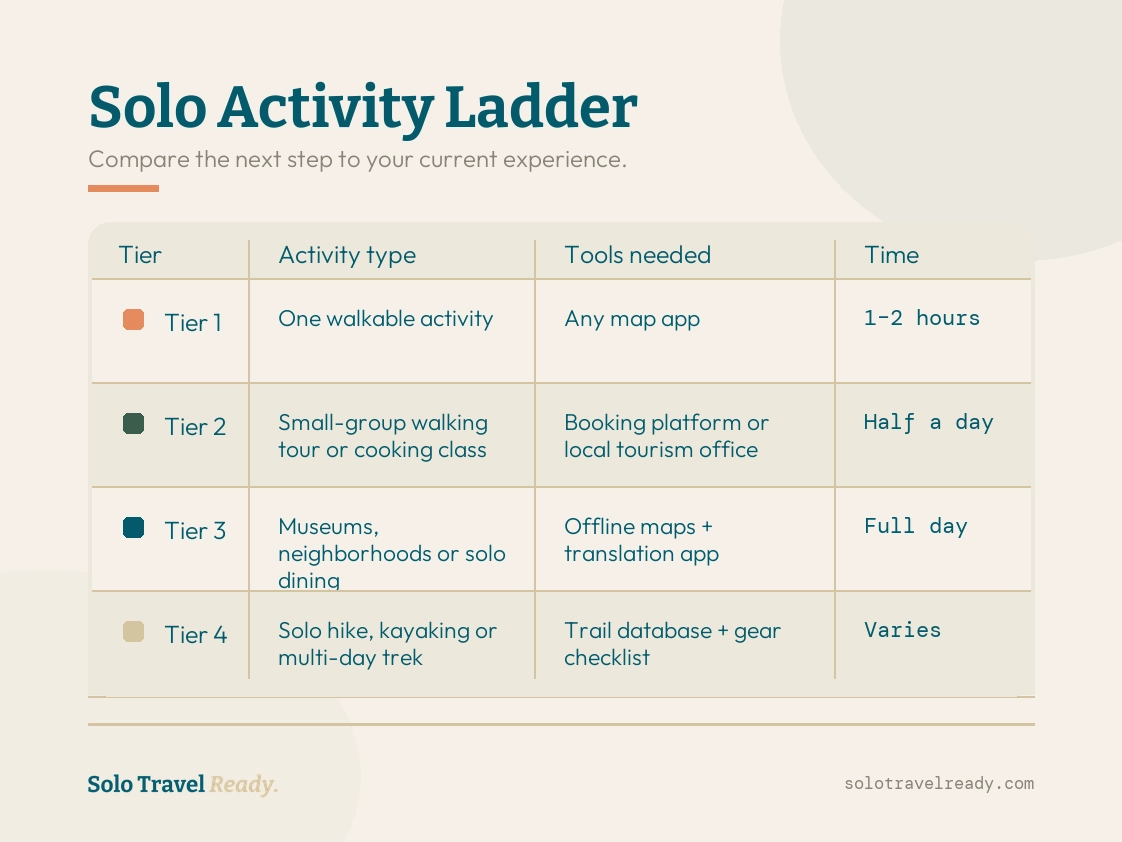
| Tier | Activity type | Tools needed | Time |
|---|---|---|---|
| 1. Local and Low-Stakes | One walkable activity, no booking | Any map app | 1 to 2 hours |
| 2. Structured and Guided | Small-group walking tour or cooking class | A booking platform or local tourism office | Half a day |
| 3. Independent Exploration | Museums, neighborhoods, solo dining | Offline maps, a translation app | Full day |
| 4. Specialized and Outdoor | Solo hike, kayaking, multi-day trek | Trail database, gear checklist | Varies |
The biggest mistake isn't picking the wrong activity. It's picking five activities for your first day. Tier 1 should feel almost too easy, and that's the point.
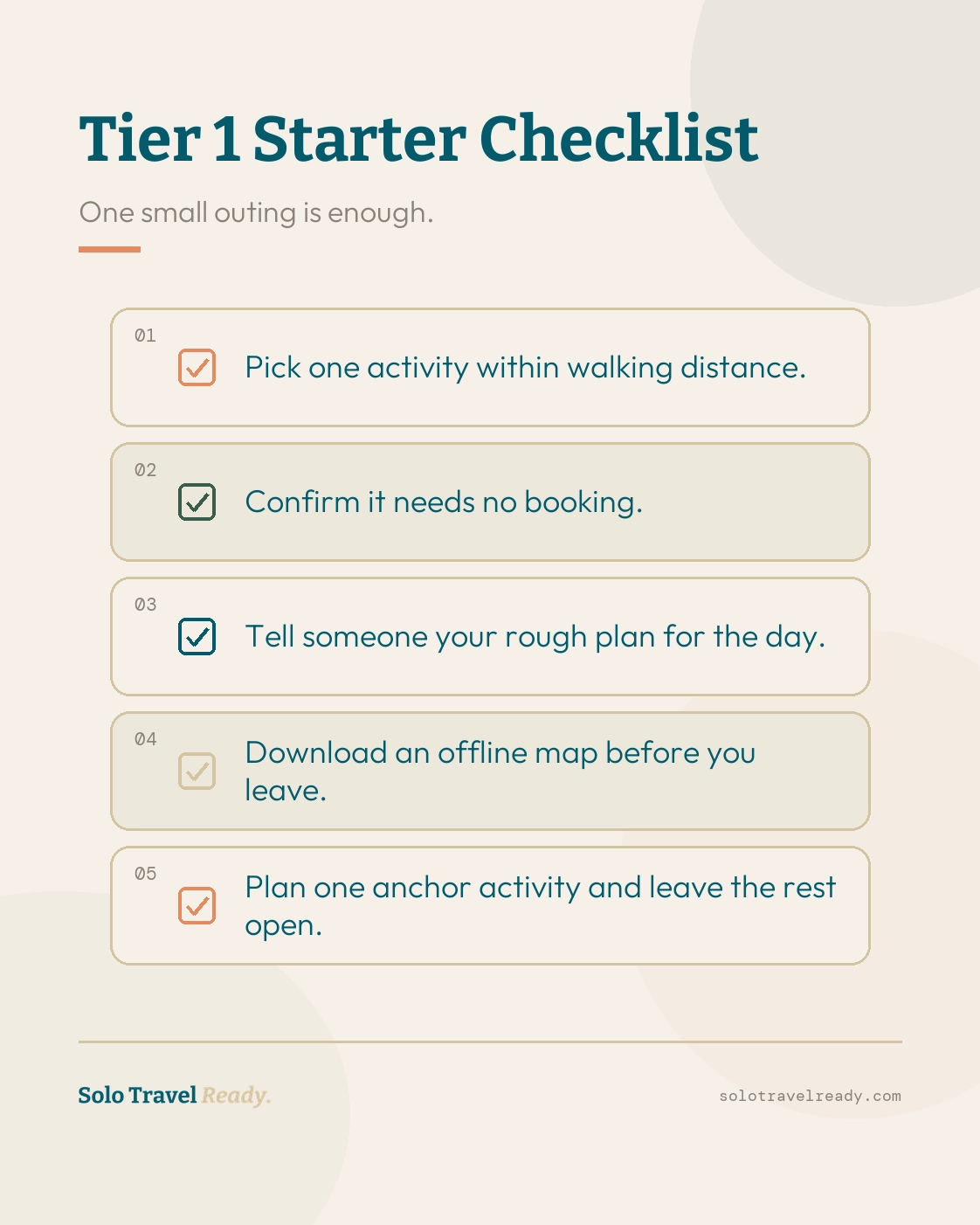
Here is the Tier 1 checklist to use for your first outing:
- [ ] Pick one activity within walking distance.
- [ ] Confirm it needs no booking.
- [ ] Tell someone your rough plan for the day.
- [ ] Download an offline map before you leave.
- [ ] Plan one anchor activity and leave the rest open.
Two warnings are worth repeating. Skipping tiers, especially jumping straight to Tier 4, is the biggest cause of overwhelm on first solo trips. And treating the ladder as a one-time label is how experienced travelers end up repeating Tier 1 activities on their fifth trip, long after they've outgrown them.
If even Tier 1 feels frightening rather than just unfamiliar, that's a different problem from choosing activities. Before you add more research, try a short meditation practice for travel nerves to settle the immediate reaction, then come back to your next Tier 1 step.
In one line each: Tier 1, start close and small. Tier 2, let a guide hold the structure. Tier 3, go fully independent. Tier 4, take on a specialized challenge.
How to Choose Your First Solo Activity
Three questions decide which tier and which kind of activity suit you today. For sequencing activities across a whole trip, a step-by-step approach to planning a whole solo trip goes beyond day one.

Choose your first solo activity by matching it to your comfort level: structured tours for planners, open exploration for spontaneous types.
The first question is whether you feel steadier with a plan or with room to improvise. If you're a planner, pick Tier 1 or 2 activities with a clear start and end time, so a scheduled walking tour beats an unplanned wander. If you're spontaneous, the reverse holds, and an unstructured walk will feel calmer than a fixed booking.
The second is whether you want company while you build confidence, or want to do it entirely alone first. That decides when Tier 2's group activities enter your sequence. Put them early if you want company. Put them after a few Tier 1 outings if you'd rather prove to yourself first that you can get around on your own.
The third is how much planning you can take before it works against you. Planners need every detail locked down to feel calm, while spontaneous types find that over-planning is the source of the nerves. Answer honestly and you'll land on a Tier 1 activity with firm logistics, like a booked museum slot, or one with none, like a walk wherever the street goes.
Activities That Help You Meet People
Loneliness on a solo trip rarely comes from being surrounded by strangers. It comes from arranging every hour so you never have to talk to anyone, then noticing the quiet. That isn't a flaw in you. It's the predictable result of choosing only Tier 1 and Tier 3 activities, the solo-by-design ones, and skipping Tier 2.
What Skills Does Solo Travelling Give You?
Solo travel builds navigation confidence and self-trust. Those skills build with each trip, so the next one gets easier.
Each tier proves one specific ability, not a vague sense of "I did it." Tier 1 proves you can find your way alone. Tier 2 proves you can hold your own in a group of strangers. Tier 3 proves you can structure a day without a guide. By the time you reach Tier 4, the skill you rely on isn't hiking. It's the self-trust built in the three tiers before it.
Why Group Activities Solve Loneliness Better Than Solo Ones (At First)
A cooking class or walking tour gives you social contact that's easy to underestimate: low-pressure, time-limited and organized by someone else. You don't have to start a conversation from nothing. The guide gives everyone a shared task, and conversation grows around it.
That's why Tier 2 sits between Tier 1 and Tier 3 and not after them. If you jump from solo walks to solo dinners, you remove the one tier built for connection, and loneliness tends to build instead of easing. If managing solo travel nerves is a bigger obstacle for you than loneliness, deal with that first, because sequencing activities matters far less until it's under control.
The first group activity often changes the shape of a whole trip, because it gives conversation a structure before you have to invent one.
The Anchor Activity Method for Unstructured Time
The Anchor Activity Method is how you handle open time without filling every hour.
One Anchor Per Half-Day
Anchor each half-day to exactly one planned activity and leave the gaps around it open. Morning gets one anchor, afternoon gets one, and evening gets one if you want it. Getting there, getting back and deciding what to do before dinner all stay unplanned.
An hour-by-hour itinerary causes a problem you can't see until it happens. With no slack, one delayed train or one closed museum knocks over the whole day, and there's no space for the unplanned moment that is often the best part. With one anchor per half-day, a single delay costs you nothing, because nothing else was locked in around it.
It also protects you from the opposite problem, a day with no structure at all, where boredom and overthinking creep in. One anchor gives the day a shape without asking you to plan the other twenty hours.
Two Solo Trips, Two Different Tiers
The ladder works the same way for everyone, but it looks different depending on where you start. Here are two of my own trips, one from the bottom of the ladder and one from near the top.
On my first solo trip, in Kuala Lumpur, I walked to the Petronas Towers, two blocks from the hotel, had a coffee and walked back. It took forty minutes. That sounds too small to count, and that's the point. I wasn't there to see the city yet. I wanted proof that I could leave, get somewhere and return with nothing riding on it. By the second day, that proof made a half-day walking tour feel like the next reasonable step.
On my third trip to Thailand, I moved from Tier 3 to Tier 4 on Koh Chang. I booked a local guide for a day hike in Trat, downloaded the trail map the night before, and told the guesthouse owner my route, the company I was using and when to expect me back. I started at 7am to be off the summit before the afternoon storms.
None of that preparation was interesting, and that's why it worked. The hike could have my full attention because the logistics were already done. What made it possible wasn't knowing Koh Chang. It was the self-trust from earlier, lower-stakes trips.
Both trips show the same thing: confidence at any tier is borrowed from the tier before it. Skip the borrowing and even a safe activity can feel unsettling. Do it in order and even a higher-stakes one, like that hike, feels manageable.
Common Solo Travel Activity Mistakes
Four mistakes cause most of the trouble. Each one comes from a reasonable instinct.
Starting at Tier 3 or 4 with Zero Experience
This usually comes from eagerness, or from comparing yourself with content that makes Tier 4 look like the default starting point. I made this mistake on my first solo trip. I went straight to a full-day countryside motorbike tour and was lost for two hours before noon. Nothing dangerous happened, but I wasn't ready.
The result can be overwhelm and early-trip freeze strong enough to cut a trip short. The fix is unglamorous: Tier 1 first, whatever your confidence or fitness.
Planning Every Hour of the Day
Nerves pushes people to over-prepare, because if every hour is accounted for, nothing can go wrong. In Ho Chi Minh City on day two of one trip I had six things in the calendar. A museum was closed for a national holiday and the sequence fell apart.
I spent three hours in a market instead, and it was a better day than the one I'd planned, but only because the collapse forced me off the schedule. A fully scheduled day leaves no room for the moments that build real confidence, and one delay brings the whole thing down. The fix is the Anchor Activity Method: one planned activity per half-day, not per hour.
Choosing Only Solo Activities and Avoiding All Group Options
This often comes from worrying about looking like someone who can't make friends, or from social nerves that makes groups feel riskier than they are. The result is that loneliness builds instead of easing, because the one tier designed to help gets skipped. The fix is Tier 2's structured group activities, which give you social contact without asking you to start it.
Treating the First Trip's Tier as Permanent
This happens when you treat the ladder as a label instead of something that updates with experience. The result is repeating Tier 1 activities on a fifth solo trip and missing growth you've already earned. The fix is to re-check your tier honestly before each trip, and not default to whichever tier felt safe the first time.
The Solo Activity Ladder at a Glance
- The ladder replaces "which solo travel activities should I do?" with "which tier am I on?" There are four tiers and always one clear next step.
- Tier 1 is local and low-stakes: one walkable activity with no booking.
- The most common mistake is skipping tiers, especially starting at Tier 4 with no earlier solo experience.
- The Anchor Activity Method, one planned activity per half-day, handles open time without over-scheduling.
- Tier 2 group activities exist to ease loneliness, and skipping them to stay independent usually backfires.
- Your first action is to identify your current tier honestly and pick one activity from it for your next trip.
Frequently Asked Questions
What are fun things to do when traveling alone?
Good things to do alone include walking tours and cooking classes. Balance exploring with quiet time. Use the Solo Activity Ladder to match a specific activity to your current tier instead of picking from a list at random.
How do I not get bored on a solo trip?
Prevent boredom by anchoring each half-day to one planned activity and leaving the gaps unplanned. One anchor in the morning and one in the afternoon is enough, and you don't need a third.
How do I learn to travel alone?
Start with a weekend trip nearby, then a 3-day regional trip, then international. Each step builds confidence before the next. That's the same logic as the Solo Activity Ladder: small proof before bigger independence.
What are the most common solo travel activity mistakes?
The biggest mistake is skipping tiers. Jumping to Tier 3 or 4 with no Tier 1 or 2 experience often brings overwhelm, and so does going abroad before any practice trips.
Your Next Solo Trip Starts With One Tier, Not One List
You began with 25 unranked options and no way to know which suited your level. That overwhelm wasn't a personal failing. It's what happens when you're handed a list with no filter.
The Solo Activity Ladder is the filter. Each of its four tiers has its own action, tools and time, and there's one honest question to answer before every trip: which tier am I on right now? Once you know, the list of solo travel activities shrinks to two or three that fit, and the ones you're not ready for stop competing for your attention.
Before your next trip, identify your tier and pick one activity from it. Not three. One.
If choosing an activity feels easy but going solo at all still feels frightening, that's a different problem. How to work through solo travel fear is built for it, and it's worth doing before you plan a single activity.
Resources Mentioned in This Guide
Apps and tools
- GetYourGuide and Viator: look for Tier 2 group activities, such as walking tours and cooking classes. Availability varies by destination, so check the current listing before relying on it.
- AllTrails: use a trail database to check the current route details and recent reports before a Tier 4 solo hike. Use an equivalent regional service where AllTrails has little coverage.
- Google Maps and Maps.me: download offline maps so you can get around on a Tier 3 day without a data connection.
Start Building Travel Readiness
Your Free Prep System.
Not tips, not wanderlust, not “just go for it” advice.
Real systems. Honest experience. One focused email a month. Get 3 Free Tools the moment you join:
1. 60-Day Solo Travel Ready Checklist
Your complete prep timeline from decision to departure
2. First 48 Hours Arrival Survival Card
The exact protocol for landing confident, not lost
3. Booking Confidence Checklist
The tool for the moment the booking button feels impossible to press
No schedule pressure. Unsubscribe any time.
About Zisco Nueda
Zisco Nueda is a solo travel educator and the founder of Solo Travel Ready. Zisco developed the Solo Activity Ladder from solo trips over more than two decades, including early ones where skipping straight to advanced activities led to real overwhelm, and it sits inside the Confidence Bridge framework taught to nervous first-timers. This guide is educational. It doesn't replace local safety information or professional advice for outdoor activities.
Last updated: October 2026