







Choosing how to get from the airport to your hotel isn’t really a search for the cheapest option. It’s four decisions in sequence: Compare what’s actually available for this arrival, Observe the real conditions against what you assumed, Select the option that fits those conditions, and Track whether it’s working so you can switch before a small delay becomes a bigger problem.
Quick answer: Choose an airport-to-hotel transfer by total cost, time, luggage, verification, and arrival hour; confirm the pickup point and keep a backup ready.
Start with the hotel and airport facts
The best option balances verified pickup, operating hours, total cost, luggage, arrival time, and a backup, not simply the lowest advertised fare.
Before comparing any transfer option, confirm three facts: your arrival terminal, your hotel’s exact address including the entrance if it’s inside a larger building, and whether your hotel operates a front desk around the clock or has restricted check-in hours. A hotel with a 24-hour desk changes almost nothing about your transfer choice. A hotel with a midnight cutoff changes everything if your flight lands late.
Questions to ask the hotel
Ask whether the property has a named pickup arrangement or preferred transfer partner, what the check-in cutoff is, and what to do if you arrive outside staffed hours. A short message before you fly often resolves this in minutes.
What to confirm before booking
Confirm your terminal (large airports often have several, each with different transit and pickup access), the exact hotel address, and whether card payment is reliably accepted for your chosen transfer mode. A transfer that only accepts cash becomes a problem if you land without local currency yet.
This same logic, mapping the route, comparing options, verifying before you commit, and keeping an exit ready, applies to every journey after this one, not just the arrival. The MOVE Stack system for getting around on a solo trip breaks down that fuller system.
Compare the main transfer modes

Compare public transit, shared shuttle, rideshare, taxi, private pickup, and rental car by total cost, time predictability, luggage fit, and required verification.
Confirm the hotel address and terminal, then compare official transit, shuttle, taxi, rideshare, or prebooked pickup using the arrival conditions.
| Mode | Cost | Time predictability | Luggage fit | Verification needed |
|---|---|---|---|---|
| Public transit | Low | Medium, schedule-dependent | Poor with more than one bag | Route, stop, and operating hours |
| Shared shuttle | Low to medium | Low, shared stops add time | Fair | Provider, pickup point, confirmation |
| Rideshare | Medium to high | High once matched | Good | Driver, vehicle, route on the app |
| Taxi | Medium to high | High | Good | Official queue, meter or fixed fare |
| Private pickup | High | High | Good | Driver name, sign, meeting point |
| Rental car | Varies | High once collected | Good | Rental desk hours, insurance, route |
Cost
The advertised fare rarely reflects the full cost. Airport surcharges, tolls, and after-hours rates can change a shared shuttle’s real price relative to a rideshare, and a shuttle’s shared-stop time can turn a cheap option into the slowest one on a tired night.
Time and luggage
More luggage narrows your realistic options faster than cost does. Two checked bags and a personal item make public transit with stairs or multiple transfers a genuinely worse choice even when it’s the cheapest line on the comparison table.
Verification and exit points
Every option on this table has one thing to verify before you commit: a route and stop for transit, a provider and pickup point for a shuttle, a driver and vehicle for rideshare or a taxi, a name and meeting point for a private pickup, and a desk’s operating hours for a rental car.
If public transit is the mode you land on, navigating public transit safely on your own walks through ticket systems and platform verification in more depth.
Choose by arrival conditions
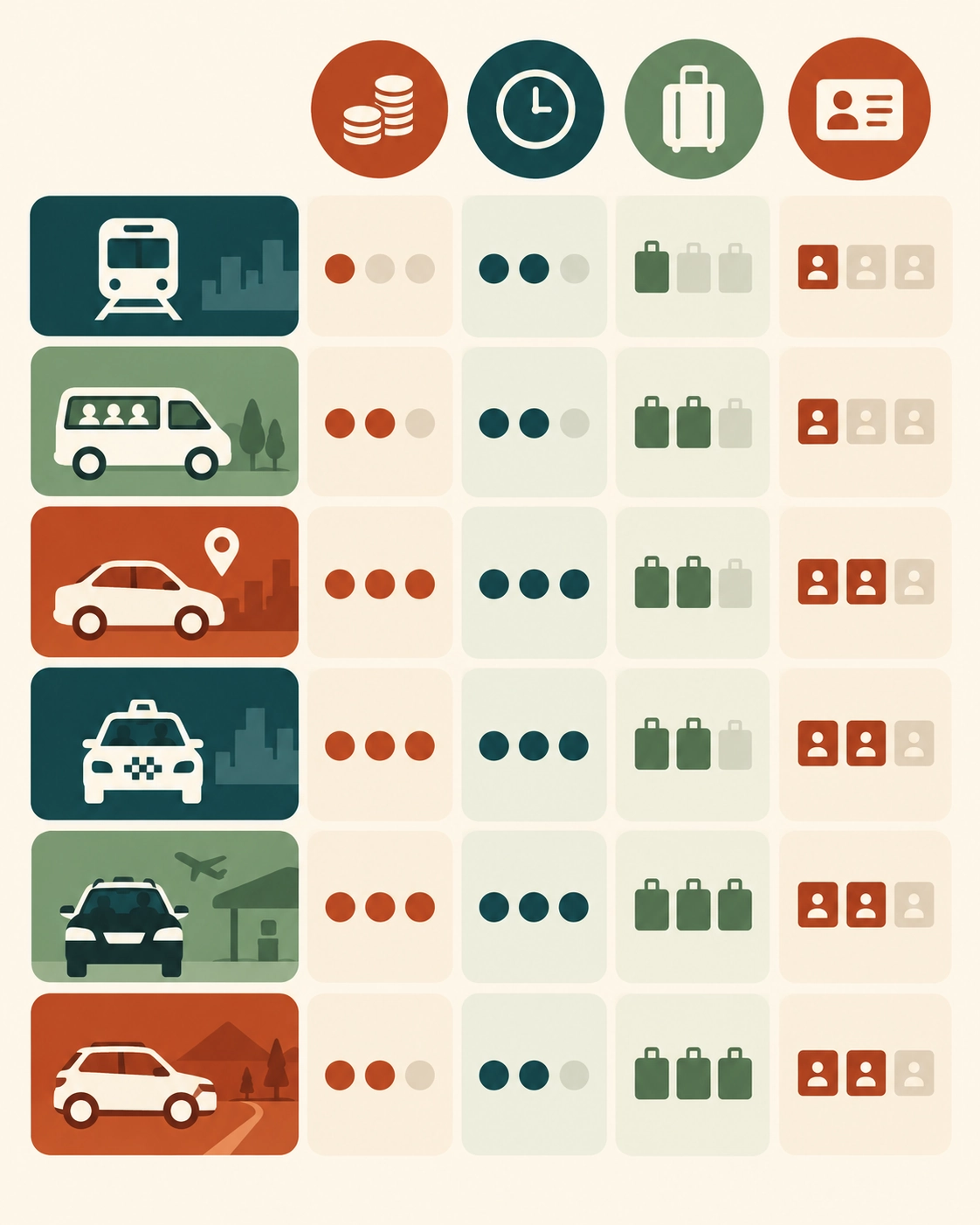
Daylight and light luggage can favor transit, while late arrival, heavy luggage, or unfamiliar terminals can favor a prebooked transfer or rideshare.
Daylight and light luggage favor public transit; late arrivals, heavy luggage, or unfamiliar terminals favor a prebooked transfer or rideshare.
Daylight, a light bag, and a well-served terminal favor public transit or walking to a shuttle stop. A late arrival, heavy luggage, or an unfamiliar terminal favor a prebooked transfer or rideshare, even at a higher price, because the added reliability is worth more than the savings once you’re tired and it’s dark. For the fuller comparison of city transport once you’re past this first transfer, the full transport decision matrix for a new city explains the same logic applied to every later trip.
When public transit fits
Public transit fits when your arrival is during normal operating hours, your luggage is light enough to manage stairs or a walk to the stop, and you have a saved route rather than a plan to figure it out on arrival.
When a prebooked transfer is worth it
A prebooked transfer is worth the higher price when you’re arriving after standard transit hours, carrying more than you can comfortably manage alone, or landing somewhere you have no data plan yet and don’t want to be comparing apps at 2am.
I learned this comparing a shared shuttle to a private transfer somewhere in Southeast Asia. The shuttle was cheaper on paper, but its extra stops cost more time than the pricier option would have.
Verify the ride or pickup
Compare the final fare, airport fees, surge pricing, pickup friction, payment, and luggage, not just the first price shown in either app.
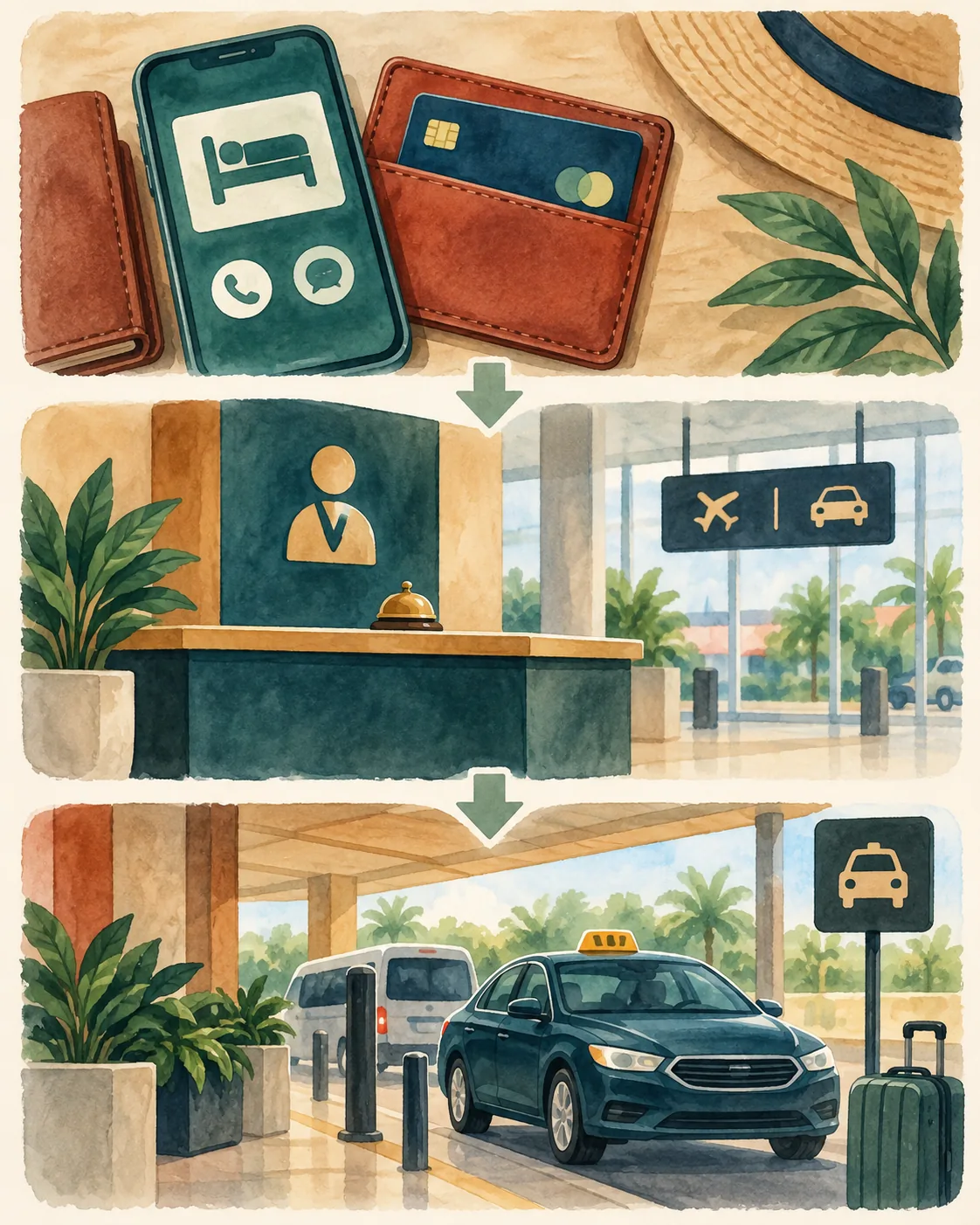
Use official queues or the agreed meeting point, and confirm the driver, vehicle, route, and booking details before entering.
Whichever mode you choose, verify it before you commit. For a taxi, use the official taxi queue rather than an offer from someone who approaches you inside the terminal. For rideshare, confirm the driver’s name, vehicle, and plate match the app before getting in. For a private pickup, confirm the driver is holding a sign with your name or booking reference at the agreed meeting point, not just standing near it. If more than one detail doesn’t match, don’t get in. Wait, re-check the booking, or move to your backup option instead. Comparing ride-hailing apps and their safety features runs through app-specific verification features if you’re relying on rideshare as your primary or backup option.
Airport pickup safety
A verified pickup means the vehicle, driver, and route roughly match what you were told to expect. A mismatch on any of those, especially route, is worth pausing over even if everything else looks fine. For the broader risk-checking habits this one verification step is built on, see the risk-literate safety system for solo travelers for the wider pattern.
Avoiding pressure at arrivals
Arrivals halls often have unofficial drivers offering rides directly to passengers. A confident, calm “no, thank you” and a walk toward the official queue or your prebooked meeting point is the simplest response, and it works the same way in most airports no matter the language.
Build the backup before landing
Use a prepared fallback: a verified taxi or pickup area, a hotel contact, a charged phone, and flexible payment to reach the accommodation.

Save the hotel contact and backup payment, identify an official taxi or pickup fallback, and move to staffed help if the booked transfer does not appear.
Before you land, decide your backup now, while you have time to think clearly, rather than after your first plan has already failed. That means knowing the official taxi queue location as a fallback even if your primary plan is a prebooked transfer, having your hotel’s phone number saved in case you need to confirm a late arrival, and carrying at least one payment method that doesn’t depend on a specific app working.
Late-night fallback
If you’re landing very late, confirm in advance that your fallback option (usually an official taxi queue) actually operates at that hour, since not every service runs around the clock. A prepared message to the hotel confirming a late arrival also prevents a booking mix-up at an unstaffed desk.
If the booked transfer does not appear
If a prebooked transfer isn’t at the agreed point after a reasonable wait, move to a staffed information point or the official taxi queue rather than continuing to wait indefinitely or approaching an unofficial driver. For the full sequence on regrouping when a plan falls through entirely, the first-landing sequence for a solo arrival shows the steps before this decision point.
Examples
Normal case: A traveler lands mid-afternoon, confirms the hotel address and terminal exit, and takes a rideshare booked directly at the arrivals curb without incident.
Friction case: A different traveler’s flight is delayed until well past midnight, past the operating hours of the shuttle they’d planned to use.
Recovery case: That traveler checks their backup, an official taxi queue confirmed to run overnight, sends the hotel a message about the delay, and reaches the accommodation using the fallback rather than waiting for a service that’s no longer running.
FAQ
What is the best way to get from airport to hotel?
The best option balances verified pickup, operating hours, total cost, luggage, arrival time, and a backup, not simply the lowest advertised fare.
How do I get to the hotel from the airport?
Confirm the hotel address and terminal, then compare official transit, shuttle, taxi, rideshare, or prebooked pickup using the arrival conditions.
Is it cheaper to take a taxi or an Uber from the airport?
Compare the final fare, airport fees, surge pricing, pickup friction, payment, and luggage, not just the first price shown in either app.
What should I do if I arrive after transit stops?
Use a prepared fallback: a verified taxi or pickup area, a hotel contact, a charged phone, and flexible payment to reach the accommodation.
Start Building Travel Readiness
Your Free Prep System.
Not tips, not wanderlust, not “just go for it” advice.
Real systems. Honest experience. One focused email a month. Get 3 Free Tools the moment you join:
1. 60-Day Solo Travel Ready Checklist
Your complete prep timeline from decision to departure
2. First 48 Hours Arrival Survival Card
The exact protocol for landing confident, not lost
3. Booking Confidence Checklist
The tool for the moment the booking button feels impossible to press
No schedule pressure. Unsubscribe any time.
Author Box
Zisco Nueda is the solo travel educator behind Solo Travel Ready, who developed the Compare, Observe, Select, Track sequence in this article to answer one recurring problem: the cheapest transfer on paper is not always the cheapest transfer once a delay or a language barrier gets factored in, a lesson from a Southeast Asia arrival where a shared shuttle’s extra stops cost more time than the pricier private option would have. Transfer pricing, provider availability, and operating hours vary by city and by date, so verify current details against the airport’s or provider’s official information before you travel.
Last updated: September 2026