







There’s no single best ride-sharing app, because availability changes by country and city. What travels well across every market is the process: Compare what’s actually available where you are, Confirm the specific ride before you commit, Enter only once it checks out, Check in so someone knows your route, and Exit with your belongings and a plan for what’s next.
Quick answer: Choose a ride-sharing app by local coverage, final price, pickup clarity, safety tools, and backup support; verify the vehicle before you enter.
Define what the app must do
An app must have local coverage, transparent pricing, an accepted payment method, a usable language, and a way to share your trip with someone.
Before comparing specific apps, decide what actually matters for your trip: does the app operate where you’re going, does it show a clear price before you book, does it accept your payment method, does it work in a language you can navigate, and does it offer a way to share your trip with someone else. Everything past this list is a nice-to-have, not a requirement.
Essential versus nice-to-have features
Local availability, transparent pricing, and trip sharing are essential. Loyalty programs, driver ratings beyond a basic threshold, and in-app entertainment are not.
Availability changes by country and city
The app that works well in one country may not operate at all in another, or may operate with a smaller driver pool and longer waits. Check current availability for your specific destination before you rely on any single app as your primary plan.
This is the same comparing, verifying, and backup-switching sequence that applies to every transport decision on a trip, not just rideshare. The MOVE Stack system for getting around on a solo trip runs through that fuller system.
Compare ride-hailing options

Compare available ride-hailing options for local coverage, pickup clarity, final price, support, identity and plate matching, trip sharing, and a backup option.
Popularity varies by market; compare available apps for coverage, pickup clarity, price, support, and safety controls before booking.
Global apps like Uber and Lyft operate in many but not all cities. In markets where they don’t operate, or operate with limited supply, a local ride-hailing app, a taxi-aggregator app, or a regulated taxi service often fills the gap, sometimes with better coverage than the global option. Compare whichever apps are actually available at your destination using the same criteria: transparent pricing before you commit, clear pickup location, and a way to verify the driver and vehicle. There’s no app that wins everywhere, and a guide that claims otherwise is describing one market, not a universal rule.
I’ve found this true whether I was booking a ride in Bangkok or in Dubai: the app brand told me almost nothing, but matching the driver’s plate against the app every single time told me everything.
Price comparison
Sometimes a local app, taxi aggregator, or regulated taxi costs less; compare the final fare, fees, wait, pickup friction, and cancellation rules.
The quoted price before booking rarely tells the whole story. Compare the final fare including any surge pricing, booking fee, or airport surcharge, not just the number shown at the moment you open the app.
Coverage and vehicle supply
An app with few active drivers in your area will show long wait times or no available rides at all, no matter its global reputation. Check for available vehicles nearby before assuming an app will work at your specific location and hour.
Safety and support features
Look for identity and plate matching, in-app trip sharing, an in-app support channel, and a visible route map during the ride. These features matter more than brand recognition when you’re checking out an app for solo use.
Verify the pickup
No app makes every ride safe; prioritize identity and plate matching, trip sharing, official pickup points, in-app support, and a backup plan.

Match the driver and vehicle to the booking, use the designated public pickup zone, and cancel rather than accept an unplanned change.
Before you get in any vehicle, match the driver’s name, photo, and vehicle plate against what the app shows you. At airports and large venues, use the designated pickup zone shown in the app or on official signage rather than accepting a pickup at an unmarked curb. If a driver asks to change the pickup or drop-off point in a way that doesn’t match your booking, treat that as a reason to cancel and rebook rather than agree over the app’s messaging. This identity-matching habit is one piece of a larger pattern, and the wider set of checks is explained in the risk-literate safety system for solo travelers.
Airport and venue pickup rules
Many airports and venues restrict ride-hailing pickups to a specific zone, separate from taxi queues or public transit stops. Follow the app’s in-app directions or the venue’s signage rather than the first vehicle that looks like a plausible match.
What to do when the driver asks for an unplanned change
A request to meet somewhere other than your confirmed pickup point, or to pay outside the app, is a signal to cancel that specific ride and request a new one rather than go along with the change.
Use the ride with a check-in routine
Share your trip through the app, keep the route map visible, and confirm the actual path still matches what the app originally showed you.

Share trip details where available, keep the route visible, notice mismatches, confirm the destination before exiting, and check for belongings.
Once you’re in a verified vehicle, share your trip details through the app with a trusted contact if that feature is available, and keep the in-app route map visible so you can see whether the actual route matches the expected one. Choose a seat with a clear view of the route and door if you have the option.
Share the trip
Sharing your live trip status takes a few seconds and means someone else can see your route and estimated arrival in real time, without needing to send updates yourself.
Recognize a route or identity mismatch
The vehicle’s route might go noticeably off the path the app shows, with no clear reason like traffic or a road closure the driver mentions. Or something about the driver or vehicle might not match your original confirmation. Either way, say so directly and ask for an explanation. If the concern doesn’t go away, contact in-app support.
Exit and recover
Many people use rideshares alone, but use identity checks, trip sharing, public pickup points, route monitoring, and support tools every time.
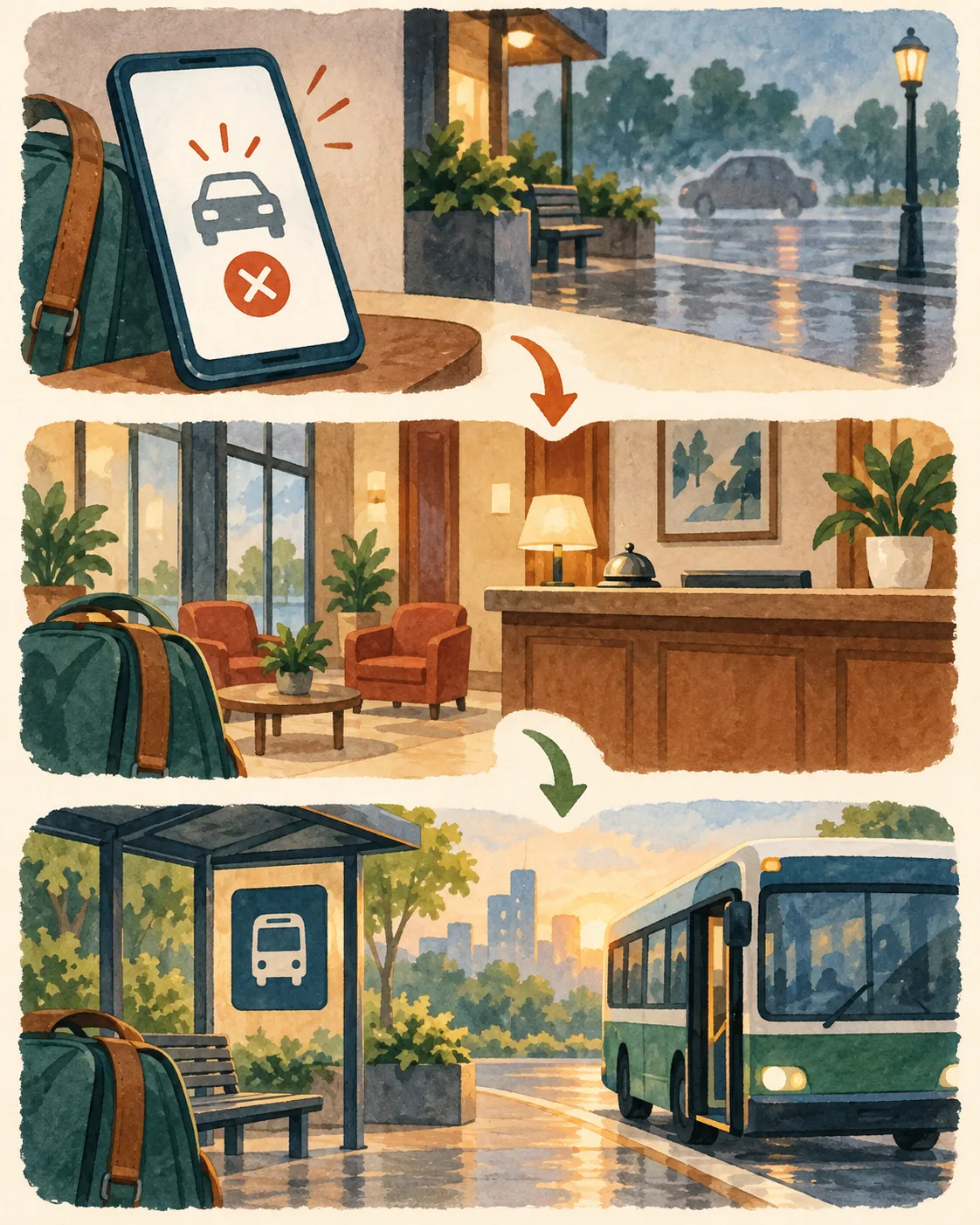
Request another ride once, then switch to a backup option or a staffed public place if cancellations repeat or data fails.
Confirm you’ve arrived at the correct destination before you get out, check for belongings left in the vehicle, and rate or report the ride if something didn’t match expectations. If a ride is cancelled after you’ve been matched, request another rather than waiting to see if the same driver reappears. Comparing offline-capable navigation apps handles what to use for confirming your location if the app’s own map disagrees with what you’re seeing outside the window.
If the ride is cancelled
A cancelled ride is routine, not a personal failure of the plan. Request again immediately, and if cancellations repeat, switch to your backup option (a taxi queue or a different app) rather than continuing to retry the same one.
If the phone or data fails
If your phone dies or loses data mid-request, move to a staffed, public location and use your backup plan: cash or a card for an official taxi, or a borrowed connection to rebook. The recovery sequence for when a route fails maps out the fuller recovery sequence if losing your ride-hailing option leaves you without a clear next step.
Examples
Normal case: A traveler compares two available apps at their destination, books through the one with clearer pricing, matches the driver and plate before entering, and shares the trip with a contact for the ride.
Friction case: Midway through a different trip, the driver takes a route that diverges noticeably from the app’s shown path with no explanation given.
Recovery case: The traveler asks the driver directly about the route change, and when the explanation doesn’t add up, contacts in-app support through the chat feature while still in transit, noting the discrepancy for the record even though the ride itself continues without further incident.
For a route comparison beyond rideshare alone, the full transport decision matrix for a new city sets out when a different mode might have been the better call for that leg.
For the first-airport version of this same comparison, comparing transfer options from the airport to your accommodation applies the same verification logic to that specific journey.
FAQ
Which ride sharing app is most popular?
Popularity varies by market; compare available apps for coverage, pickup clarity, price, support, and safety controls before booking.
Which ride sharing app is the safest?
No app makes every ride safe; prioritize identity and plate matching, trip sharing, official pickup points, in-app support, and a backup plan.
Is there a rideshare cheaper than Uber?
Sometimes a local app, taxi aggregator, or regulated taxi costs less; compare the final fare, fees, wait, pickup friction, and cancellation rules.
Is it safe to use a ride-share app alone?
Many people use rideshares alone, but use identity checks, trip sharing, public pickup points, route monitoring, and support tools every time.
Start Building Travel Readiness
Your Free Prep System.
Not tips, not wanderlust, not “just go for it” advice.
Real systems. Honest experience. One focused email a month. Get 3 Free Tools the moment you join:
1. 60-Day Solo Travel Ready Checklist
Your complete prep timeline from decision to departure
2. First 48 Hours Arrival Survival Card
The exact protocol for landing confident, not lost
3. Booking Confidence Checklist
The tool for the moment the booking button feels impossible to press
No schedule pressure. Unsubscribe any time.
Author Box
Zisco Nueda is the solo travel educator behind Solo Travel Ready, who built the Compare, Confirm, Enter, Check-in, Exit sequence in this article around one consistent finding across many cities, true whether the city was Bangkok or Dubai: the verification step, not the app brand, is what actually determines whether a ride goes smoothly. Ride-hailing app availability, pricing, and safety features vary by market and change frequently, so verify current details directly through the app and official local sources before you travel.
Last updated: September 2026